
BS 8214:2026 Explained: A Practical Guide to Fire Door Hardware Selection
What Is BS 8214:2026?
BS 8214 is the British Standard for the installation and maintenance of fire door assemblies in non-domestic premises. The 2026 revision updates guidance on whole-door-set specification, ongoing maintenance obligations, and the evidence required to demonstrate that a door assembly remains fit for purpose. It does not replace the need for professional assessment, but it does raise the bar on what specifiers and installers are expected to document and verify.
This guide is written in plain trade language to help you understand the key practical requirements when selecting and specifying fire door hardware. It is not legal advice and does not constitute a compliance statement — always refer to a competent fire door inspector or surveyor for project-specific decisions.
Whole-Door-Set Compatibility: Specifying Hardware as a System
One of the central principles of BS 8214 is that a fire door is only as good as its weakest component. Hardware must be specified and tested as part of a compatible assembly — not selected piecemeal. Key points for trade specifiers:
- Test evidence must cover the full assembly. Each hardware item — closer, hinge, seal, latch, lock — should have test or assessment evidence that is compatible with the door leaf, frame, and glazing configuration being used.
- Third-party certification is the benchmark. Look for products tested to BS EN 1634-1 (fire resistance) and, where applicable, BS EN 13501-2 classification. Certifire, UKCA-marked, or BM TRADA Q-Mark certified products provide a traceable evidence trail.
- Door leaf and frame ratings must align. Fitting FD60 hardware to an FD30 doorset — or vice versa — is not acceptable. Confirm the door leaf rating and select hardware accordingly.
- Supplier data sheets matter. Retain the technical data sheet and test evidence for every component specified. This documentation forms part of the required specification evidence under the updated standard.
Required Specification Evidence
BS 8214:2026 places greater emphasis on documented evidence at the point of installation and throughout the door's life. As a specifier or installer, you should be able to produce:
- Test reports or certificates for each hardware component confirming the fire performance classification
- Manufacturer installation instructions, followed and retained on file
- Evidence of compatibility between components (e.g. closer and hinge loading, seal activation temperature vs. leaf material)
- A record of the installed specification — ideally a door schedule that identifies make, model, and reference for every item fitted
- Photographic records of the completed installation where practicable
For projects subject to the Building Safety Act 2022 (higher-risk residential buildings), a golden thread of information linking specification evidence to the installed door is a regulatory requirement, not just best practice.
Maintenance Records
BS 8214 has always required fire doors to be maintained in good working order, but the 2026 revision reinforces the expectation that maintenance is documented and periodic. Responsible persons (typically building owners or facilities managers) should ensure:
- Regular inspection cycles — at least annually for most premises, and more frequently in high-traffic locations such as corridors, stairwells, and escape routes
- Inspection records are retained — recording the date, inspector, findings, and any remedial actions taken
- Like-for-like replacement only — if any hardware item is replaced, it must match or exceed the specification of the original component. Substituting a non-certified product voids the door assembly's tested status
- Closer adjustment is documented — closer power settings and any adjustments should be noted, particularly if the door is in a high-traffic or draught-exposed location
Selecting Hardware: Component-by-Component
Door Closers
Closers are arguably the most performance-critical component of a fire door — if the door doesn't close fully and latch, it won't perform as intended in a fire event. Key selection criteria:
- Power size: select to EN 1154 with a power size appropriate to the door weight, width, and exposure to wind/draught. Undersized closers are a common failure point.
- Backcheck: recommended on external or high-traffic doors to prevent slam damage
- Delayed action: useful in accessibility and care settings
- Hold-open models: only use on fire doors where connected to an automatic release system linked to the fire alarm. Free-standing mechanical hold-open devices are not compliant on a fire door.
For automatic release hold-open closers and electromagnetic hold-open devices, see our Fire Door Hold Open Devices collection.
Hinges
Fire door hinges must be tested as part of the door assembly and rated for the door's weight and frequency of use. Minimum specification guidance:
- At least 1.5 pairs (3 hinges) for FD30 and FD60 doors in most configurations — confirm with door manufacturer's test evidence
- Stainless steel or steel construction — avoid unrated zinc alloy hinges on fire doors
- Frequency class to BS EN 1935: CE4 or above is appropriate for most commercial and residential communal doors
- Matching finish within the doorset for a coordinated, specification-compliant result
Intumescent Seals and Smoke Seals
Seals serve two distinct purposes: intumescent seals expand in heat to close the gap between door and frame; smoke seals restrict cold smoke passage. Both may be required depending on the door's rating and location:
- FD30S and FD60S doors require both intumescent and smoke seals
- Seals must be compatible with the door leaf and frame material — confirm with the seal manufacturer's test evidence
- Retrofit seals must not be used to upgrade an unrated door to a fire door — they must be part of an assessed assembly
- Check activation temperature: standard intumescent seals activate between 150–200°C; some door assemblies require specific grades
Locks and Latches
The latch is the final line of defence that keeps a fire door closed. Specification points:
- A latch (or lock in latch mode) must be present on all fire doors — a fire door held closed only by a closer without a positive latch is not compliant
- Select CE-marked locks/latches to BS EN 12209, with fire test evidence appropriate to the door rating
- Deadlocks on escape routes must be operable from the inside without a key (thumb-turn or lever handle)
- Cylinder grade and anti-pick/drill/snap ratings are important for security, but do not affect fire performance independently — both need to be specified
- On FD30 and FD60 door assemblies, check that the lock/latch case dimensions are within the tested aperture size for that doorset
Fire-Rated Sliding Door Hardware
Sliding fire doors present additional specification challenges because the hardware — track, rollers, guides, and any hold-open mechanism — must all be part of a tested assembly. Standard swinging-door hardware is not transferable.
- Only use hardware with fire test evidence specific to sliding-door configurations
- Pocket door kits (concealed sliding systems) require additional confirmation that the pocket frame does not compromise the wall's fire resistance
- Automatic sliding fire doors linked to the fire alarm system require specialist commissioning and ongoing maintenance records
Browse our Fire Rated Pocket Door Kits for tested sliding-door hardware solutions.
Door Signage
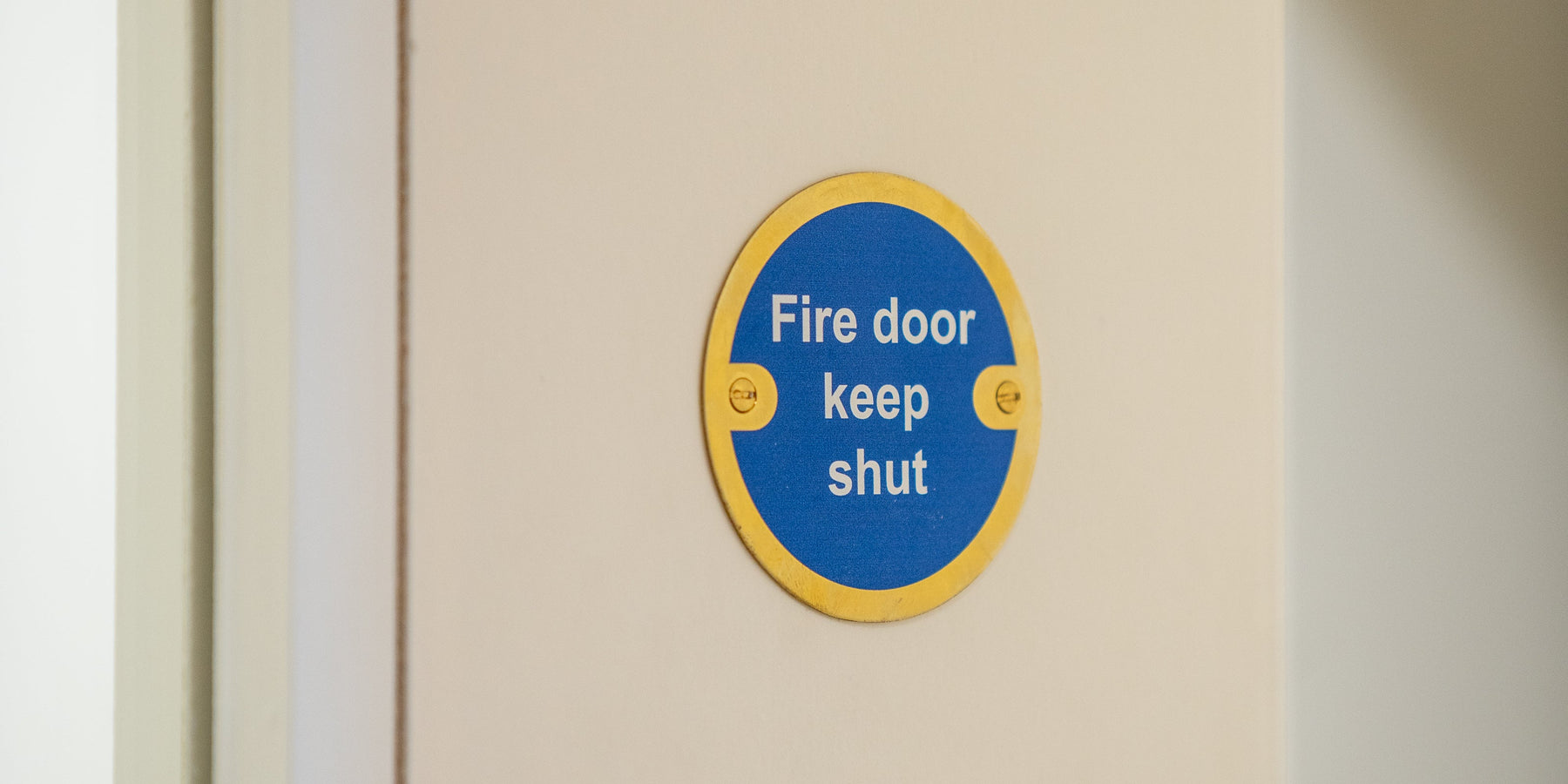
BS 8214 and the Regulatory Reform (Fire Safety) Order both require fire doors to be clearly identified. Fire door keep shut and Fire door keep locked signs must be displayed on both sides of a fire door (except the non-public face of a final exit door). Signage should conform to BS EN ISO 7010 and be durable enough for the door's environment.
View our compliant Door Signs collection for a range of fire door signage options.
Summary: Specifier Checklist
- ☐ Confirm door leaf and frame fire rating (FD30 / FD30S / FD60 / FD60S)
- ☐ Select hardware with compatible test evidence for that rating
- ☐ Verify hinge count and load rating against door weight and width
- ☐ Confirm closer power size for door dimensions and exposure
- ☐ Specify intumescent and smoke seals appropriate to the S-suffix requirement
- ☐ Ensure latch/lock is included and tested within the assembly
- ☐ For sliding doors, confirm all track and hardware is part of a tested sliding-door assembly
- ☐ Retain all technical data sheets, certificates, and installation instructions
- ☐ Fix compliant fire door signage to both sides
- ☐ Establish a maintenance schedule and inspection record from day one
This article is provided as general trade guidance only. It does not constitute legal advice, a compliance certification, or a substitute for professional fire door inspection and assessment. Always engage a competent person for project-specific specification and installation.


